
Note from Japan
Hi readers, I’m writing this from Japan toward the end of a speaking tour to support the Japanese publication of The More Beautiful World Our Hearts Know is Possible. (Last event is Friday night in Tokyo.) The country is making a strong impression on me. The conversations, stories, and observations that have arisen are becoming a powerful influence on the book I’m writing now. I’ll share a rough version of one of the ideas that has taken shape here.
As I have visited various places over the years, I have become aware that each nation, culture, and land has a unique and necessary gift for the world. The president of the publishing company is an 80-year-old man, Ishigaki-san. He has a very deep relationship to the spirit world. Ishigaki-san shared with me a prophecy that came to him through two separate pathways. First, an English lady received a message in a séance to come to Japan to find a person who embodied a truth that would unify all religions. So she came, looking for such a person, but could not find one. She was about to leave when she finally encountered Ishigaki’s spiritual mentor, Yaoi Nissho, to whom she related the prophecy. Many years later, a shaman showed up at Ishigaki’s office and, possessed by a spirit, delivered the same prophecy.
I do not think this “truth that will unify all religions” takes the form of a wise statement or universal declaration that resolves the age-old theological conflicts among the world’s faith traditions. Truth need not take the form of words. On this trip, visiting sacred sites and meeting old and young people, farmers and engineers, midwives and writers, looking at mountains and buildings, I am getting a hint of Japan’s gift to the world (one of many — I could also write about its gift culture and the light and dark sides of its ethic of humility), and it is not something I can put into words either. Dare I be so arrogant, given my short time here? Well, sometimes the crude eyes of a newcomer can see something useful, so I will try.
This is the country that in all the world first experienced the pinnacle of modernization followed by the end of growth. (Japan’s GDP has been stagnant for over 30 years; its population has started to decline as well.) And, while much of traditional spiritual practice was submerged in the tide of modernity, now that the tide is receding I wonder what hidden treasures may emerge from the waterline. The overt spirituality may be dormant; modern people may consciously repudiate it (in large part because the Japanese felt betrayed by state Shintoism, which led to the catastrophic defeat in World War Two); however, the material imprint of that spirituality remains in the exquisite care, formality, etiquette, and aesthetic attention to detail that informs many aspects of Japanese life. The modern built environment, the industrial cityscapes built post-WWII, are quite ugly, but the smaller places, the homes, the shrines, the household objects, the packages, embody a recognition of the sacredness of matter. And I think the unification of world religions has something to do with that: the reunion of spirit and matter. Modernity has treated the world as profane, a source of materials, a waste dump. Any “spirituality” worthy of the name will reverse the desecration of our earth.
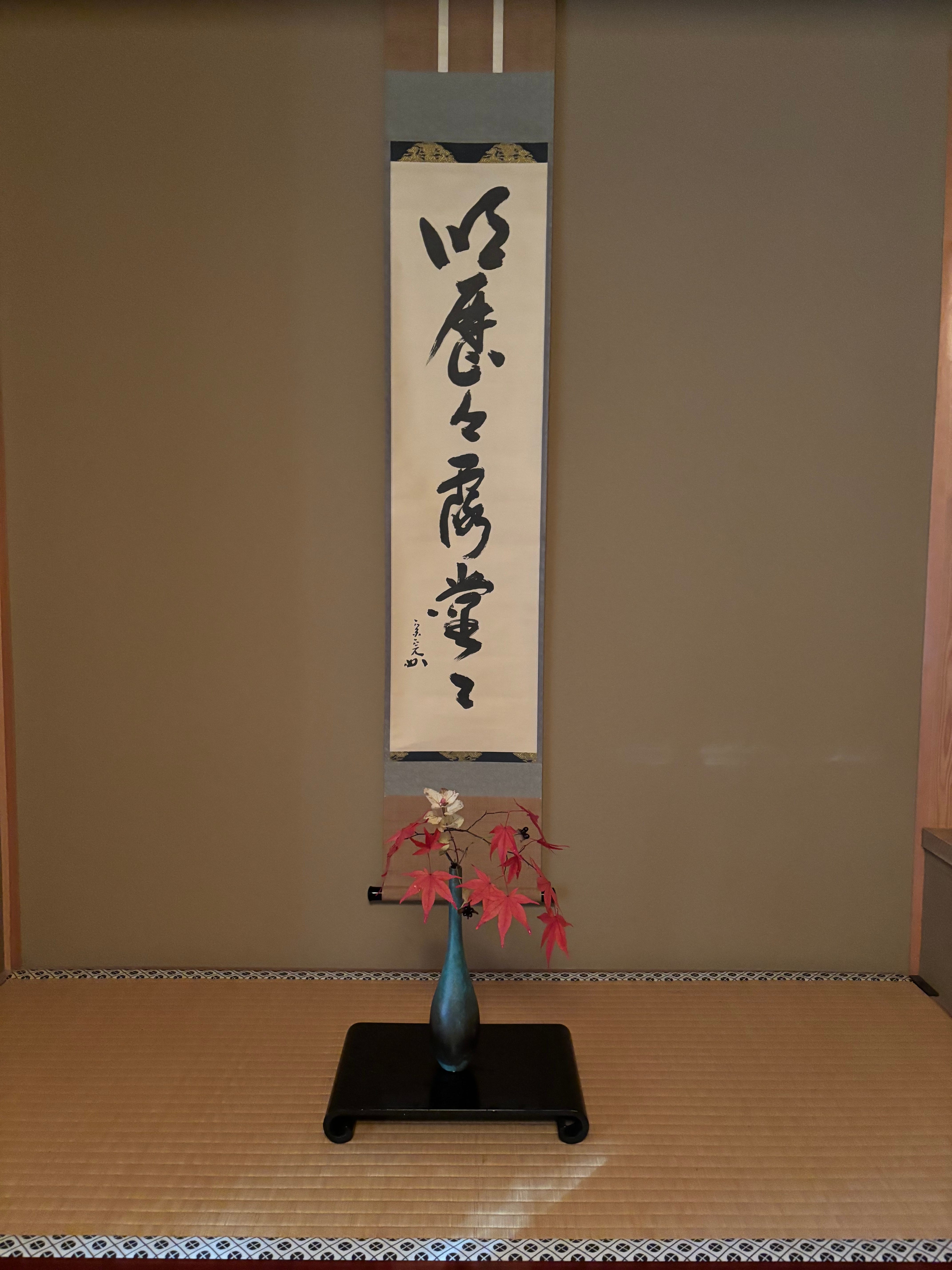
This is the decor of the tea room where I was served tea today.
The aesthetics of Japan are not a mere decoration on modern efficiency. They are part of the source code that will one day transform modernity.
Ishigaki-san is always careful to emphasize when speaking of a particular deity, that it is not the god of this river or this forest; the god is this river or this forest. The built shrine marks a sacred place, but it is not itself what is sacred. That teaching is inseparable from Japanese aesthetics.
Whether it is mainstream religion or New Age spirituality, modern religion has often been a flight from materiality into a spiritual realm, relocating the sacred to somewhere else. That escape is quite understandable—we crave refuge from the dispiriting ugliness and regularity of the modern built environment. But we have not come to this world to escape it; we have come to transform it, to resuscitate it. Every land, every people, every nation carries codes of reunion. The more modernized a people or a place, the more deeply submerged those codes may be, the more marginalized, the more pathologized, but they are there to be discovered and shared.
Any of you who travel—and it doesn’t have to be to a foreign country—if you look for the gift of that place you may find it, or it may find you, and you may receive its imprint and carry it forward. That is my prayer on this trip. Thank you.
I’m not posting much these days because I’m working on a book. But if you want to support me as I do so, you can choose a paid subscription. Thank you!